The Sheepdog Coalition

PhotobucketPhotobucketPhotobucketPhotobucketPhotobucketPhotobucketPhotobucket
Advertise with us! For opportunities email our Admin.

Showing posts with label bushcraft. Show all posts

Saturday, June 11, 2011

Are you a bushcrafter, or a backpacker?

Today we have a really exciting opportunity. One of our readers and regular commentators, Haliboy - contacted our admin to just add a personal note to some of his comments. On talking a little more, Haliboy offered this article as part of an opinion piece he posted on a forum. Thanks Haliboy.


*


ARE YOU A BUSHCRAFTER OR A BACKPACKER?
Haliboy

Bushcraft or Backpacking? My take on it is that while certain people have been using the term "Bushcraft" for years, I think of Mors Kochanski here in Canada, and Americans like Nessmuk used "Woodcraft” (the original 1920 title, later changed to "Woodcraft and Camping") and Kephart used the term “Woodcraft” as part of the title of his book called "Camping and Woodcraft"; however the term "Bush" and "Bushcraft" are largely a UK and more so an Australian term. In North America we have woods; in Australia they have the bush. In North America we have woodsmen while in Australia they have bushmen.

It was not until the popularity of both TV and the Internet that North Americans really started to pick up on the term Bushcraft from British shows like those put out by Ray Mears. Before that people were content to use the terms, "Backpacking" and "Hiking" for their activities and books.


Where is the difference? If your list of "bushcraft" gear looks identical to what you can find in any backpacking book today (tent, sleeping bag, pot, water filter, wash kit, first aid kit, compass, stove, etc.) you are just packing backpacking gear. Cry as you might, your gear is no different and no cooler than a "Backpacker” that time honoured American term. On the other hand, if you plan on making your shelter, using a wood fire to cook your meals, perhaps even not using a pot, then you are Bushcrafting which is to say you are crafting what you need to live out of the bush. The key part to Bushcrafting is in the crafting. If all you do is go is set up a nylon tarp made in some factory, use an axe made in some factory, start your fire with a firesteel made in some factory, and cook food you got from some store, then you are Backpacking my friends.

Is it wrong for a Bushcrafter to carry Backpacking gear? No, certainly not, and indeed Backpacking gear is needed by the beginning Bushcrafter as a safety net while he builds up his Bushcrafting skills. No matter how skilled at Bushcrafting you are, I would still recommend that you carry modern survival gear as a back up should things go wrong. Also, rather than carry a haughty attitude that you are better than your Backpacking brothers, pack along some humility due to the fact that you are reading this on a plastic and silicon computer and likely got to the woods by driving a truck that is made of metal and much plastic.

In closing, let’s look back to our heroes both old and modern. Hephart, Nessmuk, Kochanski, and Mears all used various gear that was made by someone else; they were recent people of European decent, not Aboriginals living off the land thousands of years ago. The difference between these men and Backpackers were the amount of skills/crafts they employed while in the woods. Backpacking is largely a self-contained activity that has gotten away from the destructive 50’s Boy Scout days of digging a ditch around your tent, cutting tall saplings every time you need poles for your canvas tent, and cutting down several trees for each night’s fire. The Brushcrafters of today are a much more environmental group who see the hypocrisy of bringing all that stove fuel and petro-based nylon from many hundreds of thousands of miles away into the woods compared to the careful and measured use of natural resources right where they are found.

Sunday, April 10, 2011

How To Tie The Monkey's Fist - HD

Very well done tutorial on this particular knot - used by me for finishing paracord lanyards.

Sunday, April 3, 2011

Buddy Burner


After reading a post on CGN, I ventured out to my local dollar store to pick up material.

I got - 10 'emergency' candles. Just straight white wax candles, about an inch think by an inch and a half tall. Yep. That's about it.

I took an old soup can and bent the top to make a little spout.

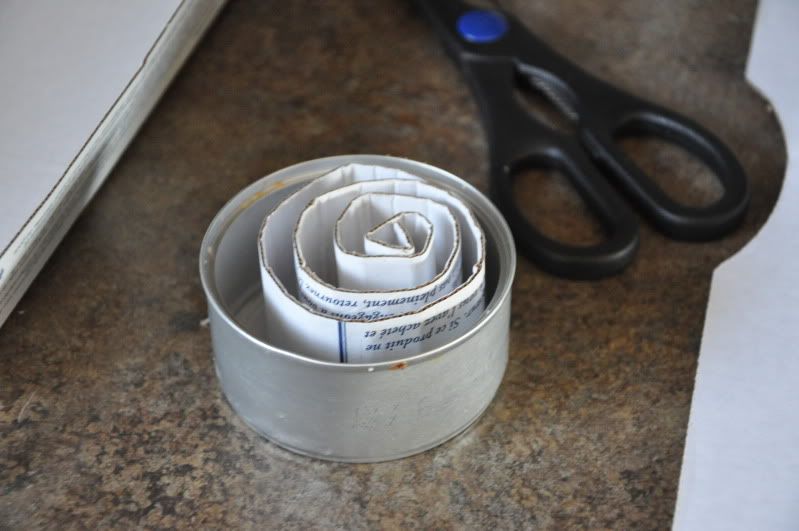
I gathered 4 old catfood cans I had been collecting since hearing about this project - cleaned out and the label taken off.

I also gathered a bunch of sawdust from work. More on that later.

One more thing I got ready was a few egg carton shells.

So - the basic premise is this; I wanted to make 2 things, a couple firestarters and a few 'buddy burners'. I added the sawdust that I used to make the firestarters to the buddy burners, hoping that if I ever needed them as a firestarter as well, they could double as such.


Under no circumstances should this article be taken as a 'you should do' speech. These instructions are provided as educational material only.

So, I put my 'wax can' in a pot of water and put the heat on high. As you can see I put a little divet in the can to aid in pouring the wax. I cut some strips of cardboard out and rolled them into the cans of catfood - directions taken from above CGN post.


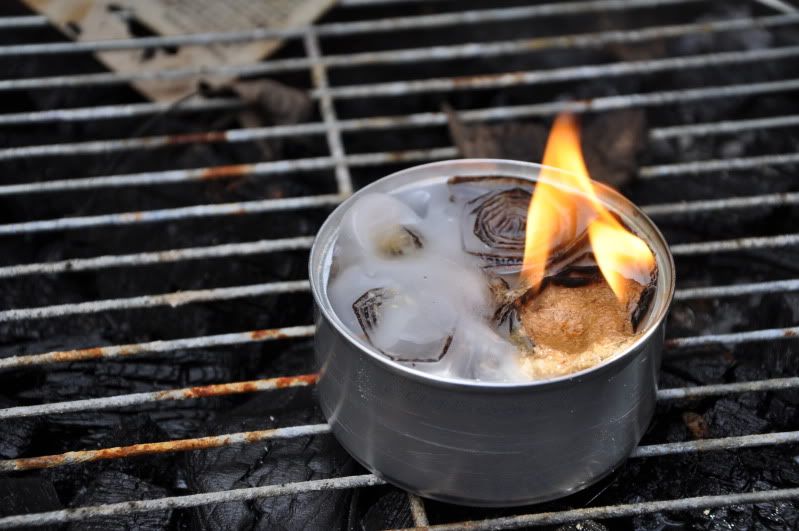
Once some wax is melted down, I poured it on top of the cardboard and sawdust in the little cans. I put wax in the egg cartons as well, mixed up with sawdust for little firestarters. It all worked well, as far as I know. We tested them out in the backyard - they worked really well and I'll be adding them to my camping and hiking kit.

Thursday, March 17, 2011

Pioneer Tools: The fixed blade

This series of articles is going to talk about what I will call pioneer tools. Everybody has their preferences when it comes to tools I certainly have mine I have been a woodsman most of my life. And I feel that there are a few basic things somebody should have with regards to bare minimum tools. Most all of these could be carried on your body with ease so you would have little risk of losing them.

Fixed Blade Knife

The first will be a proper fixed blade knife. A quality blade carries with it many capabilities such as gutting, skinning and dressing fish or game, crafting tools out of wood or even stone, defensive purposes, digging holes and many other things. As you know blades come in all forms of steel and trying to pick out one from the other can make your head spin. I wouldn’t worry too too much about what steel the blade is made from I would be more concerned about these three things.

  • Quality Control
  • Full Tang
  • Quality of Sheath

Quality Control: Buy a proper brand name knife. Avoid the temptation of what I call gun show specials those cheap fixed blade knives you see in hunting shops that don’t come with a box or a brand name. You want something strong and effective not something that is going to break on you the first time you baton it through a log. Buy cheap. Buy twice.

Full Tang: A full tang basically means the blade and hilt are a single piece of steel which ensures that the blade isn’t going to break away from the hilt as easily. Very simple make sure the blade is a full tang design. When buying online it should say somewhere in the product info that the knife is a full tang.

Quality of Sheath: Polymer, leather and cordura nylon are by far the most standard materials for sheaths I prefer leather or polymer out of personal preference. But as long as the sheath is made from quality materials it will be fine. Look at a sheath similar to looking at a pistol holster buy something durable that is going to work when you need it to.

Carry Method: The carry method for fixed blade knives is most commonly affixed to the belt line. Some people rig up shoulder harnesses, lash the sheath to backpacks and other such things. But nine times out of ten the belt line is where I would carry a blade. And I would not use a standard pants belt. I would personally use some sort of belt capable of bearing weight. This could cost some money but the comfort issue will be worth the extra cash you spend.

Another option would be a pistol belt and belt keepers. These are little loops that attach to your pants belt that you then attach to the pistol belt. Keeping to two together to reduce bouncing and increase comfort.

And finally you could look into suspenders that you can affix to a pistol belt. Similar to the webbing style of load bearing gear used by military forces. This allows you to balance the weight on your shoulders and hips taking stress off of your lower back. However this isnt the most low profile of options.

So first on the kit list a quality fixed blade knife Bill posted a review on a SOG blade not too long ago. Next time we will talk about the axe and hatchet.

Monday, February 28, 2011

The "Shemagh Pouch" experiment part one

So I wanted to see what I could do to carry gear with just a shemagh and some shoelaces. This wasent meant to represent a real survival kit I will build a proper kit at a later date. I just wanted to see how much I could fit in it.

I have a video on it I am working on getting it uploaded at the moment. In the mean time here is a video by Dave Canterbury of Wilderness Outfitters on the topic the only difference is that his is carried as a backpack where as mine is carried like a messenger bag.


In a couple of weeks I am going to improve on this and build a dedicated buscraft kit for the "Shemagh Pouch" and take it for a test spin. I might also try and make an arrow quiver out of a shemagh once I get into traditional archery.

Cheers folks
Jorden