The Sheepdog Coalition

PhotobucketPhotobucketPhotobucketPhotobucketPhotobucketPhotobucketPhotobucket
Advertise with us! For opportunities email our Admin.

Showing posts with label emergency. Show all posts

Wednesday, June 8, 2011

The affects of Adrenaline

Affects of Adrenaline

There are a few things in this world that people truly will never get to experience and that is the affects of a huge adrenaline surge. I am not talking about sky diving, bungee jumping or taking part of in an extreme thrill seeking sport.

I am talking about life or death, fighting off a human predatory attack (which by the way has nothing 'human' about it) and surviving the assault.

When the mind perceives a "live or die" threat it will pump a huge amount of hormones and adrenaline into body. There are several well documented affects that occur under this stress environment.

These affects may happen and are completely random in nature depending on the individual involved.

The first thing to occur is that the body constricts blood in its extremities and pools the blood into the lungs and heart to provide maximum physical exertion to the body. We loose small motor skills and only large motor skills can be used. Good luck hitting a slide lock lever on your pistol with your thumb or putting a key into a lock, you will not feel your fingers and your hands will be shaking.

The pooling of this blood can also cause people to loose their bowls or vomit as the bladder, sphincter and stomach are just not all that important at the time. Since they do not contribute tot he immediate survival of the body, the brain takes away the blood located in them. If that happens to you or anyone else, it is not a sign of a coward or fear. They just had a full bladder or gut at the time of the adrenaline dump.

The cornea on your eye will flatten to allow as much light as possible in and to focus onto your threat. The outer ring of your vision will be blurred and what is twenty feet away will appear to be five feet away. This is "tunnel vision" and many people involved in a life threatening attack recall this. I have personally talked to an officer involved in a shooting and he said he could read the make and caliber on the steel casing that were slowly tumbling out of his gun and across his view.

That brings me to the next side affect of adrenaline. Time distortion. Time will feel like it slows down, and in a way it does but only for the person experiencing the adrenaline dump. Because the brain works in a hyper vigilant role under stress, instead of processing 5 mega bites per second it will process 50 mega bites per second (as an example). Since you are processing more information time seems to be moving slower. Hence the officer interviewed described to me the slow moving steel casings tumble from his gun.

An other thing that occurs is 'auditory exclusion'. This occurs when the brain only wants visual input about the threat because we are visual creatures. At this moment the brain doesn't need to process information from what it hears so it shuts down the information. I have heard countless accounts of people not hearing police sirens, screams from other around them or even gun shots. They usually describe a quiet, surreal environment. It doesn't take a lot of stress from the brain to do this, ask any hunter if they hear the deafening thunder of their rifle when they shoot at an animal. They normally don't.

An other interesting anomaly is that people under such sever stress can have "distracting thoughts". Some people report hearing voices from instructors, the call of loved ones or even such odd things as thinking about the grocery list while they are fighting to survive. Odd, yes but I have personally experienced this and while odd at the time it never slowed me down.

An other very common affect of adrenaline is "the shakes". This usually occurs when the threat is over and the adrenaline chemical is leaving the body. It is a common side affect of the adrenaline wearing off, the hands, the knees the legs will shake. It is not a sign of cowardice, it is just an adrenaline hangover that the body gives us and it usually dissipates after a few minutes.

So, why should we know all of these weird and wonderful affects of adrenaline? So that when it happens to us, understanding what happens to our body and mind will allow us to deal with the event better. Not only during but after to allow us to mitigate the affects of critical incident stress.

As an example lets just say you are involved in a critical incident and have fought for your life and won. You had your world slow down and heard nothing around you while you dealt with the stress, you even had thoughts of your loved ones creep into your mind causing you to fight harder while you fended off a human predator.

Now its over and you can barely walk properly as your legs start to shake and your hands rock like they have been hit with an earthquake. Your stomach starts to turn and as you hold yourself up on a wall you vomit all over your shoes.

If you did not know about adrenaline you might have thought that you were about to die because of the "out of body experience" you had as time slowed down, the world went quiet and you day dreamed about loved ones. This may cause you stress because you might feel that you gave up and were ready to stop that fight. We know that no matter what we never give up so you may beat yourself up over that.

Puking all over you shoes, the shaking and the weak legs may affect you negatively if you think it is cowardice to do so. Heaven forbid you were cursed with a full bladder at the time.

But now armed with information you will know that all of these things are out of your control, that they are normal human responses to an abnormal situation. You can look back at that event and minimise the critical incident stress because you know that those reactions were just your body adjusting to a natural chemical.

Taking that a step further, if you see someone else who has those affects running through them, educate that person. Let them know that the shakes, etc are normal. Relieve the stress of self subjection that they might be going through.

Thanks for your time, stay safe, John Smith.


Wednesday, April 27, 2011

DIY - Oil Lantern


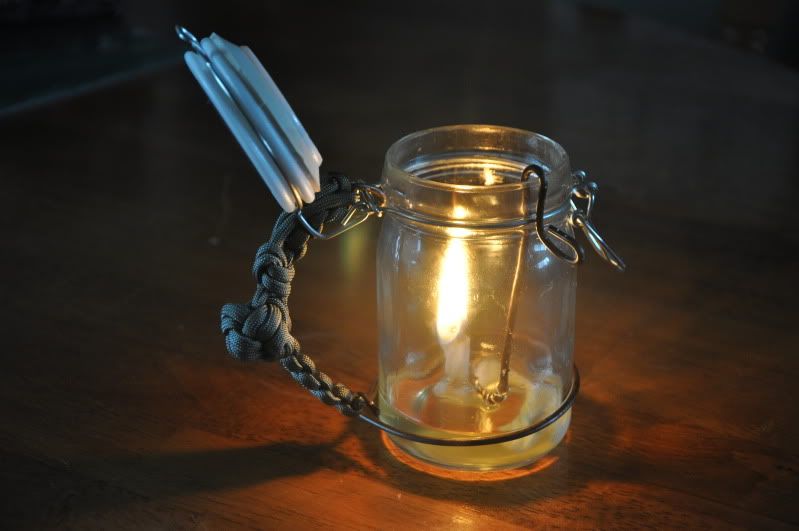
These things have multiple uses - from an emergency light source to a functional backyard ornament. It's very cheap to make and very efficient lighting - in comparison to other things I found around the house... candles, tea lights. Of course, nothing comes close to some of my flashlights in terms of light output, but in terms of a make-fast solution, this more than fits the bill.

I went to the buck store today to get material to try this out. I had posted a youtube video about this and have been meaning to test it out ever since. I had originally just wanted to use this, as stated, in the backyard in the summertime for a bit of ambient lighting. That said, I can absolutely see the value in this type of project for use in an emergency. Even just the knowledge of how to pull it off - if you didn't want to make one right away.

I got a couple different sized mason-type jars with fold over lids. The rest I had laying around the house.


Other items I used were a bit of paracord, a couple peices of cotton rope from a mop head, a wire coat hanger and a bit of trapping wire.

I cut off pieces of the wire hanger to act as a handle for both the jar itself and a separate one for the wick - to be able to adjust it if need be. I used the bit of trapping wire to secure the wick. I used the paracord to cobra-stitch the handle with a decorative monkey fist knot on the end.

Basically - follow the youtube link I posted and have at it. Test your kit before you need it - and have a big BBQ, it's a great excuse to make a bunch of these.

Tuesday, March 22, 2011

Field Expedient Butterfly Wound Closure

Found a nice package of butterfly closures at my local Shoppers Drug Mart. I'm trying to build up two things - a blow out kit for range days and a level II FAK.

Here's a fantastic video done on makeshift butterfly closures - in the case you need them, but don't have them.


Tuesday, March 15, 2011

Sheepdog Mindset - 50 wokers stay behind to help


You wake up, get ready for work and without warning, your world falls apart. Earthquake, tsunami and now, the worst case scenario. After multiple explosions, fires and an official state of emergency - this accurately describes the last few days for 50-some-odd workers from the now infamous atomic energy plant in Japan.

These people went to work. The difference is, in the face of almost certain death, they stayed. Most of us cannot imagine this type of decision. Forsaking everything to help. Nevermind a few hours of your time to help change a tire. Don't compare it to treating a casualty at some accident. These people will almost certainly die. They might DIE.

I hope this doesn't come across as being alarmist. It's the reality of the situation. These people are actively putting their lives on the line for the rest of us. For the future. It almost sounds like some b-side movie script, but it's the god-awful truth. I can not accurately put into words the things I feel about this situation. These people, are heroes.

That's a word that is all too often tossed around, especially in the west. These workers have absolutely no obligation to stay behind, though they do. They are not being forced - many have evacuated, yet still... they stay.

These workers are the direct personification of the sheepdog mindset.

I'm not a religious man - but workers... heroes... god speed.

Tuesday, March 1, 2011

The Conflict Curve

Today we are going to talk about the conflict curve. This is a scale that was developed by Michael Lund in his book Preventing Violent Conflicts. This is a graph used to illustrate how conflict can be both violent and non-violent, and how the use of force in violent conflict tends to rise and fall over time. The curve also helps organize terms and concepts used by conflict management professionals, showing how a conflict's different phases relate to one another and to various kinds of third-party intervention.

The course of disputes that become violent conflicts is traced in relation to two dimensions: the intensity of conflict (the vertical axis) and the duration of conflict (the horizontal axis)." The line that forms an arc from left to right across the diagram portrays the course of a conflict as it rises and falls in intensity over time. Its smoothly curving bell shape is oversimplified to characterize an 'ideal type' life history. As suggested by the arrows that deviate from the line, the course of actual conflicts can exhibit many different long and short life-history trajectories, thresholds, reversals, and durations. Even conflicts that have been resolved can re-escalate quickly. Nevertheless, the model has value in allowing us to make certain useful distinctions among the conflict management interventions that relate to different levels of intensity.

The column on the left describes relations between parties to the dispute and is divided into various phases of peace or conflict, Durable Peace, Stable Peace, Unstable Peace, Crisis, and War—with lower intensity phases characterized by what Lund calls interactive, mutually accommodative behavior, such as debates and negotiations and higher intensity phases characterized by unilateral, coercive behavior, such as ultimatums, sanctions and physical force. The best way to understand the model is to take a close look at each of these phases.

Durable Peace involves a high level of reciprocity and cooperation, and the virtual absence of self-defense measures among parties, although it may include their military alliance against a common threat. A ‘positive peace’ prevails based on shared values, goals, and institutions (e.g. democratic political systems and rule of law), economic interdependence, and a sense of international community.
Even in a state of durable peace, disagreements will arise on any number of issues, but these disputes will be resolved through Peacetime Diplomacy or Politics, whose objectives include maintaining and strengthening stable relations and institutions.

Stable Peace is a relationship of wary communication and limited cooperation (e.g. trade) within an overall context of basic order or national stability. Value or goal differences exist and no military cooperation is established, but disputes are generally worked out in nonviolent, more or less predictable ways. The prospect for war is low. As in durable peace, the mechanism for resolving disputes is still termed Peacetime Diplomacy or Politics.
If disputes remain unresolved and tensions continue to rise, the conflict may over time enter a phase known as Unstable Peace. This is a situation in which tension and suspicion among parties run high, but violence is either absent or only sporadic. A ‘negative peace’ prevails because although armed force is not deployed [or employed], the parties perceive one another as enemies and maintain deterrent military capabilities... A balance of power may discourage aggression, but crisis and war are still possible.

if preventive diplomacy and crisis prevention are not successful, tensions may continue to rise. Through various types of confrontation, relations may reach the phase of Crisis. Crisis is tense confrontation between armed forces that are mobilized and ready to fight and may be engaged in threats and occasional low-level skirmishes but have not exerted any significant amount of force. The probability of the outbreak of war is high.
Initiatives taken to diffuse tension during a period of crisis are termed Crisis Diplomacy and Crisis Management, whose objectives include containing crises and stopping violent or coercive behavior.
If efforts at crisis diplomacy are not successful, there may be an outbreak of violence, and the conflict may enter the phase of War. War is defined by the USIP as sustained fighting between organized forces. It may vary from low-intensity but continuing conflict or civil anarchy…to all-out ‘hot’ war. Once significant use of violence or armed force occurs, conflicts are very susceptible to entering a spiral of escalating violence. Each side feels increasingly justified to use violence because the other side is. So the threshold to armed conflict or war is especially important.

Efforts by outside parties at ending hostilities are known as Peacemaking or Conflict Management. If an agreement to end hostilities has been reached, such outside parties might then engage in Peace Enforcement or Conflict Mitigation.

Now if efforts at peacemaking and peace enforcement are successful, the fighting will subside. There may be a cease-fire such as the 38th parallel between north and south korea which may help reduce tensions and move the relationship from a state of war back simply to a state of crisis. At this point, efforts to keep the conflict from re-escalating are typically called Peacekeeping and Conflict Termination.

As the result of a settlement, the parties may begin the difficult processes of Conflict Resolution and Post-Conflict Peace Building. Through such efforts, tensions can be reduced to a point where the relationship can be described as a stable peace or even a durable peace.

This is just a quick introduction to conflict analysis For more information I highly reccomend looking into the USIP's online website for more information about the subject.

http://www.usip.org/

Cheers folks
Jorden