
The Sheepdog Coalition

PhotobucketPhotobucketPhotobucketPhotobucketPhotobucketPhotobucketPhotobucket
Advertise with us! For opportunities email our Admin.

Showing posts with label edc. Show all posts

Saturday, June 4, 2011

Equipment: On the Subject of EDC


Volumes of information exist on internet discussion boards, newsgroups and printed format about EDC, or “Every Day Carry”. At Civilian Sheepdog, we aim to cut through the hype, weed out the Gucci-Gear, and filter out the Mall Ninja. So we ask, and answer the question: What’s in your EDC?
First, let’s set the record straight. “Every Day Carry” is just what is sounds like. These are things that, without exception, are always in your possession. EDC is basic, minimalist equipment that you have in your possession day in, day out, without fail. You may substitute or augment that equipment based on specific circumstances (and in fact, you’re encouraged to), but unless you’re naked, your EDC is right where it always is, in your pockets, on your belt, or wherever you usually carry it.
EDC is simple. It’s basic. It’s a starting point, a minimalist collection of useful items that are always at hand. It’s something to build off, like a house rises from the foundation or a good fire spits to life out of quality tinder. EDC is a your first line of defence, and the backbone of your survival strategy. It provides basic equipment to meet the challenges of addressing the four basic tenets of survival; Fire, Food, Shelter and Signalling.
Remember: This is every-day stuff. These are things that are likely to be of use in any kind of emergency that’s generally foreseeable on an average day. EDC is meant to address an immediate requirement under abnormal circumstances on any given day.
My EDC is simple. It consists of a smart phone, a folding knife, a bic lighter, a $20 bill, and a pocket first-aid kit. In the interests of defining the EDC, I’ll go through each of these items and their purpose. The tools selected reflect the area I live, local laws and regulations, my experience and knowledge, and the proximity to additional resources and / or assistance I’m likely to have on any given day.
I’ll start with the smart phone; A good smart phone can provide geo-location, GPS navigation, access to maps and satellite data, and storage for books or other reading material that might just save your life. Will that help you if an Electro-Magnetic Pulse drops the grid? Probably not, but in just about any other scenario, it can be a life-saver. For that reason, a good cell phone should be a main ingredient in your EDC.
Now the folder; A knife is a simple tool, but its usefulness is nearly limitless. From opening envelopes or cutting apples, to carving stakes for a shelter or hunting, a basic blade is essential. My requirements are simple. I want a low-profile folding lock blade with an integrated belt clip, with a good edge and one-handed opening. I want a knife that can stand up to daily use, without taking up all the space in my front pocket. I usually carry a Gerber Evo, although I sometimes alternate it with one of a half-dozen other folders I’ve purchased over the years.
The lighter should be self-explanatory. Fire is part of those essential tenets, therefore, a lighter always has a place in my pocket. I actually take it a step further, with a Firesteel GobSpark™ Armageddon with its own place in the sleeve pocket of my Condor Summit Softshell jacket, but that doesn’t really qualify as “Every Day Carry”; I don’t wear the jacket daily, but I do wear it whenever the weather’s bad, and where a Bic isn’t likely to cut it.
Now on to the $20 bill. As a whole lot of people found out when the lights went out across the East Coast in August of 2003, cash is king when the power is out. That $20 lets my buy food or water, gasoline, or even bribe someone if required until I can get to my home or vehicle. In fairness, I usually have at least $60 in cash on hand, but that $20 has a sacred spot in my wallet.
Last is the pocket first aid kit. This is a small, minimalist kit that includes a couple of wipes, some Band-Aids, some Steri-strips and some Polysporin. Very basic, but always handy.
So that’s it. At any given time, I have the basics covered with my EDC. If I’m heading out on the road, I supplement that EDC with my VBSK (Vehicle-Bourne Survival Kit). If I’m walking the family through Dineyland, I supplement with my GHB (Get-Home-Bag), a Maxpedition Fatboy loaded up will additional first aid gear, water filtration bottle, purification tablets, some snacks, a map & compass and a hand-held GPS. For anything longer or dicier, I have the full blown “Bug Out Bag”.
It’s a modular approach, with the EDC serving as the cornerstone. So, what’s in your EDC?

Saturday, May 28, 2011

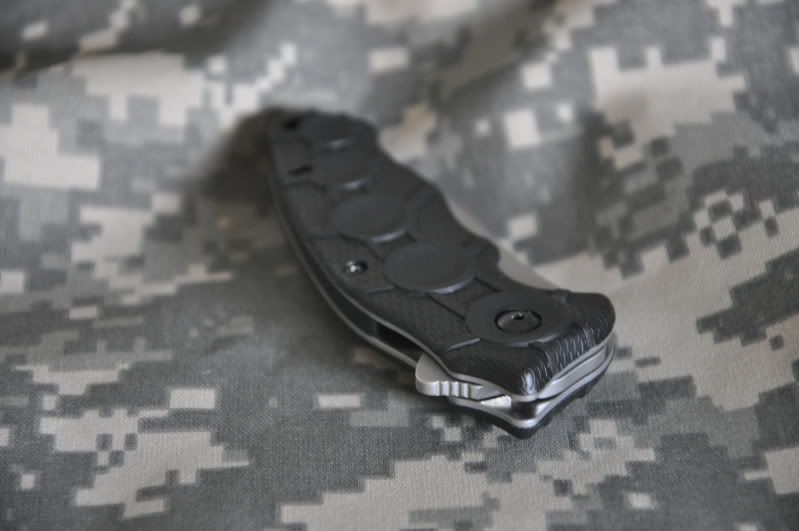
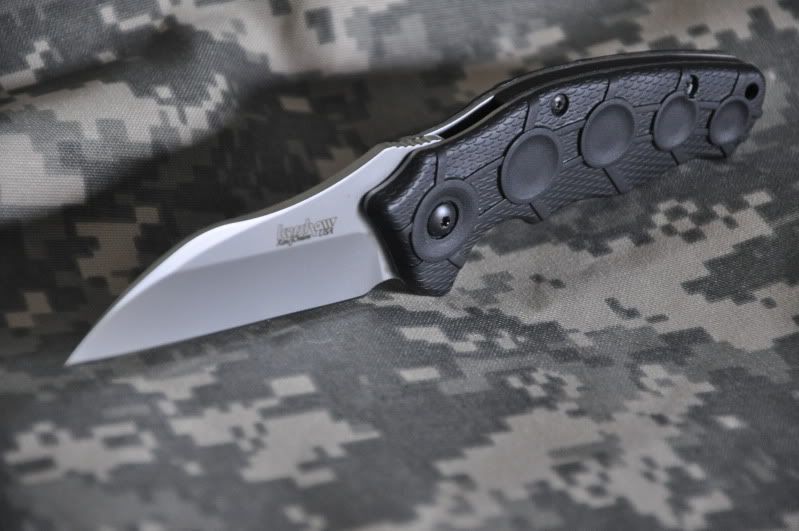
Review: Kershaw Needs Work Knife

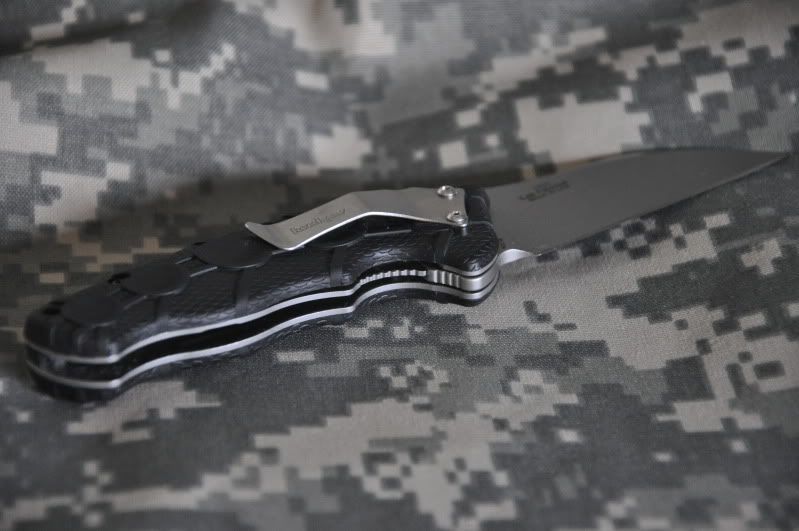
New knife - new backdrop fabric!
When I was handed this knife I asked what it was called. Ovbiously a Kershaw, scribed on the pocket clip, but I wanted to know the model name.

"Needs Work."

I almost laughed. I double checked the tag and the box. Maybe I'm missing the funny, but that's a really strange name for a knife, don't you think?

Despite it's namesake, the Kershaw Needs Work is an outstanding EDC companion knife. I wouldn't call it much more than that but seeing as I'm not a self-proclaimed 'expert' on knives, your mileage may vary.

This knife was designed by Ken Onion, renowned knife-crafter signed on with Kershaw. It features a drop point blade, a glass filled - nylon handle, an assisted open mechanism and an internal lock, to keep it open when it's open.

At first, I was also thrown back by the blade shape. I have still yet to see something like this and to be perfectly honest, I'm not sure if there's a relevant purpose behind it, or if it's mainly a cosmetic enhancement. The blade is strong, smooth and sharp - right out of the box. Passed the fingernail test with flying colours and slices through paper with little effort at all. It's quoted as a utility knife that's 'perfect for everyday carry' on Kershaw's website. With a consumer price of 64 dollars, it's not too heavy on the wallet either.


The handle has a set of circular patterns on each side. I'm sure this was clearly thought out by Ken as it not only looks decent but the top circle nicely fits the top of my thumb into it while using the knife for daily cutting activities. A nice little add-on that is probably looked over as the blade appears to be styled kind of 'space-age' but a practical design, through and through.

The knife flicks open with authority. It's assisted by a spring mechanism called the Ken Onion Speedsafe system. There is a thumb tab on the outside of the knife that triggers the blade into opening. It's just big enough to use, but not so big as to be cumbersome or in the way for the every day carrier. This knife, though matte black and very snappy, is probably not going to fall so quickly under the 'tactical' label. I guess you have to review your own philosophy of use when considering this knife for purchase. Users should check with local law enforcement before purchasing this type of blade as spring assisted knives are not legal everywhere.

The clip is awesome. Like any Kershaw knife I've ever handled, the clip is strong and springy. I'm not sure that you'd warp this spring out of regular use. I've seen pocket clips wear so easily that within a week or so of regular, standard civilian use, the knife can't even retain itself on the inside of a pocket. It's held in place by two screws, another Kershaw standard. You've got two points of pressure when the clip bends in or out - I like to think that spreads the forces out a bit so as not to focus all the pressure on one point.

There is a small hole on the bottom of the handle for tying on a lanyard or attaching the knife to some sort of retention system. We haven't done this yet, but it's definitely possible.

The locking liner has a grooved lip, easily caught by your thumb when closing the blade back into the handle. It's strong enough to withstand normal use but to be honest, I wouldn't go digging into drywall or trying to pry something apart with this knife. As nutnfancy calls it, I'd reserve this knife for the 'gentleman's EDC' crowd. There's nothing wrong with that either - every tool has it's use.


The Kershaw 'Needs Work' fits the bill for a certain type of chore. Would I take this knife on a hike? Absolutely. Would I take it to work? Everyday. Would I take it as a 'fix-all' into the woods? Probably not. Would I take it as the only option? No.

It sits nicely in the pocket and works when it needs to. There's certain mountains I'm afraid this one won't be able to climb but overall, a quality knife at a price-point that won't take appendages with it.

Monday, May 23, 2011

Review: Fenix flashlight side by side - LD20 & PD30

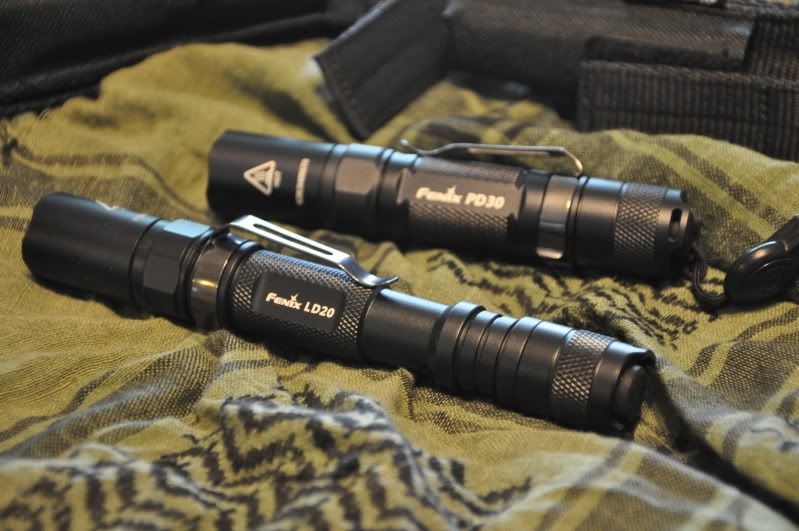
Today we're taking a look at two higher quality lights from Fenix Tactical. Each has it's own unique specifications and uses in the field. Both are what I like to call 'budget lights'. They're both very well constructed - but you're not going to save for months to buy one.

Lights from Fenix - LD20 and PD30

First we'll look at the longer of the two. The LD20 comes with a nylon sheath that is well put together - I can't see any reason you'd have to replace it under normal working circumstances. Unless you beat the heck out of it or are working under rough conditions, this should serve you well. It's got a belt loop on the back as well as a Velcro strip running along the entire length - useful as a MOLLE attachment aid.

Out of the sheath, the light is skinny. That was my initial thought - I'm used to lights that fill out my hand a little. Any hesitation I had about the light was quickly pushed aside once I put 2 double A batteries inside. The tailcap - with a clicky switch on the end, screws off to allow you to put in the required power source. The tailcap also has two attachment points for a lanyard.

The lights specifications, as listed on the Fenix site include:

Features of Fenix LD20: • Cree XP-G LED (R5) with lifespan of 50,000 hours

• Two modes with 6 types of output:
     Turbo Mode: 180 lumens (2h16m) ->Strobe
     General Mode: 5 lumens (100h) - > 30 lumens (15h) -> 81 lumens (5h57m) - > SOS

• Digitally regulated output - maintains constant brightness
• Uses two 1.5V AA (Alkaline, Ni-MH, Lithium) batteries (not included), inexpensive and widely available

Dimensions
       • Length: 150mm / 5.91in
       • Diameter: 21.5mm / 0.85in
       • Weight: 60grams / 2.1oz (excluding batteries)

• Made of durable T6 aircraft-grade aluminum
• Premium Type III hard-anodized anti-abrasive finish
• Waterproof to IPX-8 Standard
• Toughened ultra-clear glass lens with anti-reflective coating
• Push-button tail cap switch
• Capable of standing up securely on a flat surface to serve as a candle
• Included accessories: holster, lanyard, body clip, two spare o-rings and a rubber switch boot

The light came with some of these accessories, but since it was purchased at a local gun show - out of a box of lights, it's no surprise that everything wasn't included - we didn't even get a box!

The body clip is sturdy and could easily be adapted into a 'pocket light' scenario - EDC or otherwise. A couple spots on the light are kept really skinny, almost hugging the batteries inside, most likely to be used as an attachment point for use as a weapon light.

It has a number of easy-to-see modes. You can select a mode by lightly depressing the tailcap switch momentarily. From strobe to high - all modes work flawlessly.

This light may be 'too' skinny for some, but it's also a bonus feature of it as well - it's small and easy to carry without dedicating a pocket completely to it's storage. It hangs about a half inch out of either side of my hand when grasped in the middle - a larger EDC light than most but definitely viable; maybe has room to be used as an impact device as well.

 
Side by side, the only major difference is size.

The PD30 is much shorter than it's cousin, fitting in my hand completely. It's just as skinny though, and with more lumens to boot.

Features of Fenix PD30:
• Cree XP-G LED (R5) with lifespan of 50,000 hours

• 2 modes with 6 types of output:
     Turbo Mode: 257 lumens (2h37m) ->Strobe
     General Mode: 10 lumens (126h) - > 67 lumens (17h) -> 124 lumens (7h45m) - > SOS

• Digitally regulated output - maintains constant brightness
• Uses two 3V CR123A batteries (Lithium) (not included)

Dimensions
       • Length: 118mm / 4.65in
       • Diameter: 21.5mm / 0.85in
       • Weight: 53grams / 1.9oz (excluding batteries)

• Made of durable aircraft-grade aluminum
• Premium Type III hard-anodized anti-abrasive finish
• Waterproof to IPX-8 Standard
• Toughened ultra-clear glass lens with anti-reflective coating
• Push-button tail cap switch
• Capable of standing up securely on a flat surface to serve as a candle
• Included accessories: holster, lanyard, body clip, two spare o-rings and a rubber switch boot

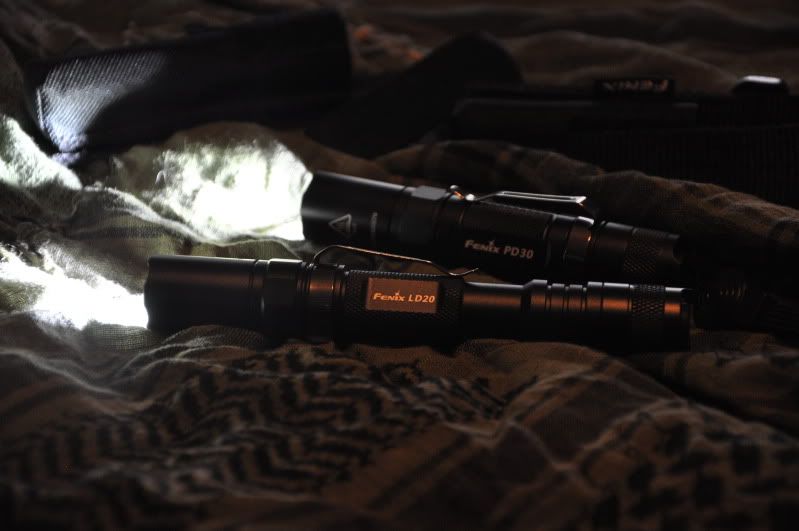
I have no way of effectively measuring the amount of light coming out of either of these lights, except a side by side 'eyeball' test. As seen below, the bottom light, the PD30 - has a different, more bright and white light.


The cost to keep this little light running is more than your mega-pack of AA's, but worth the hassle in the end. The PD30's output is much more vivid, and in a smaller package. Even in broad daylight, if you get a full-face high output beam from this little guy, you can't see who's doing it. Not only is it distracting, I haven't met someone who can just stare at the source without looking away - great as a momentary 'stun' device.

As with the LD - there are a bunch of different things you can use with this light including diffusers and filters for certain tasks. We didn't get any of these items as this light too came from a local show as a discounted item.

At work, I could easily see this being kept in the vehicle, my toolbelt or on my person. It takes up even less room and provides lots of light. It's actually a little heavier than the other, and sits well in the hand.

LD20 & PD30
Depending on your POU - either light is well worth the purchase. Both can easily be used as an EDC lightsource, or as a go-to light when needed. The smaller of the two is more likely to be used as a weapon light, just given it's size in comparison. In saying this - I'd also be more likely to carry it with me every day, in it's sheath or in my pocket.

The only person who might want to stay away from these lights is one who is more used to bigger lights. Maglites and products like them have a certain ergonomic standard to them. If you're used to using big lights, you might fumble around with these little ones - but it's something to consider, given the amount of light these ones can put out.

Monday, May 16, 2011

Review: Lacie USB 'key' - EDC tech.

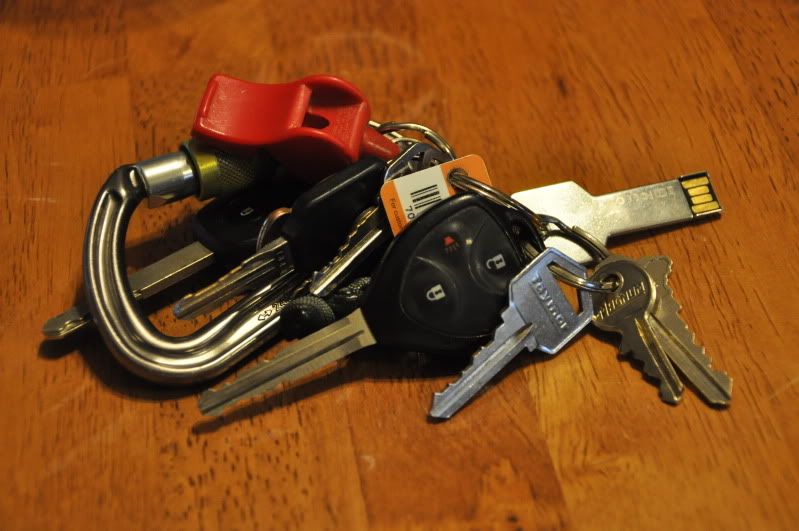
Keychain EDC - USB equipped.

EDC - or Every Day Carry, refers to items a person usually has with them, all day, every day. While this concept is not new to seasoned survival veterans, it's the first thing I bring up when discussing the topic with newbies. It can be a lifesaver - literally and figuratively, to have the right tool at the right time. That said - you don't want to be hauling too much stuff around, only what you'll usually need. That's the tricky part - what do you usually need?

Everyone's EDC selection is different and should be tailored to your own personal needs. Some might need a multi-tool, others an epi-pen. You get the idea.

Today I'll be taking a quick look at an often forgotten piece of kit; my Lacie USB 'key'. I quote 'key' because it's actually shaped like a key. This feature alone was enough for me to pick it up - always with me, hard to lose and just enough storage at 16GB to fit most everything I could use on it.

Quick to pop into a buddies computer to grab some files, to make a quick fix at work (as an IT guy, you can never have enough storage) or better yet, as a security enhancement for my shop computer. Using a program that locks the computer when I'm not using it, the only way to unlock it - even in safe mode - is to plug my key into it. Now, you could rip the drive out and get at it manually, but this is a good desktop level security feature, I figure.

I've used it a number of times, and after losing a few USB sticks that were once a part of my EDC, I have learned a few things.

- Tie something onto it that you notice on your keychain. You'll notice if it's NOT on your keychain later and makes it hard to miss if you're plugging it in to multiple PC's.
- Change the icon to something other than standard - before you close out of that computer, you might have a 'My Computer' window open and will notice it's still plugged in.

Lacie USB
To be honest - I find this key a little skinny. That's good because it keeps a low profile on my keyring; bad because I'm always worried it'll snap off in the USB slot. The key came with a little cover to hide the golden end, but that fell off in less than a few minutes. I'm not gentle with this key - my keys have been thrown around quite a bit. I've never had an issue reading the data on it, but I'm careful not to keep very sensitive stuff on it, in the case it breaks or is misplaced. OPSEC, after all.