
The Sheepdog Coalition

PhotobucketPhotobucketPhotobucketPhotobucketPhotobucketPhotobucketPhotobucket
Advertise with us! For opportunities email our Admin.

Showing posts with label tactical. Show all posts

Wednesday, June 8, 2011

The affects of Adrenaline

Affects of Adrenaline

There are a few things in this world that people truly will never get to experience and that is the affects of a huge adrenaline surge. I am not talking about sky diving, bungee jumping or taking part of in an extreme thrill seeking sport.

I am talking about life or death, fighting off a human predatory attack (which by the way has nothing 'human' about it) and surviving the assault.

When the mind perceives a "live or die" threat it will pump a huge amount of hormones and adrenaline into body. There are several well documented affects that occur under this stress environment.

These affects may happen and are completely random in nature depending on the individual involved.

The first thing to occur is that the body constricts blood in its extremities and pools the blood into the lungs and heart to provide maximum physical exertion to the body. We loose small motor skills and only large motor skills can be used. Good luck hitting a slide lock lever on your pistol with your thumb or putting a key into a lock, you will not feel your fingers and your hands will be shaking.

The pooling of this blood can also cause people to loose their bowls or vomit as the bladder, sphincter and stomach are just not all that important at the time. Since they do not contribute tot he immediate survival of the body, the brain takes away the blood located in them. If that happens to you or anyone else, it is not a sign of a coward or fear. They just had a full bladder or gut at the time of the adrenaline dump.

The cornea on your eye will flatten to allow as much light as possible in and to focus onto your threat. The outer ring of your vision will be blurred and what is twenty feet away will appear to be five feet away. This is "tunnel vision" and many people involved in a life threatening attack recall this. I have personally talked to an officer involved in a shooting and he said he could read the make and caliber on the steel casing that were slowly tumbling out of his gun and across his view.

That brings me to the next side affect of adrenaline. Time distortion. Time will feel like it slows down, and in a way it does but only for the person experiencing the adrenaline dump. Because the brain works in a hyper vigilant role under stress, instead of processing 5 mega bites per second it will process 50 mega bites per second (as an example). Since you are processing more information time seems to be moving slower. Hence the officer interviewed described to me the slow moving steel casings tumble from his gun.

An other thing that occurs is 'auditory exclusion'. This occurs when the brain only wants visual input about the threat because we are visual creatures. At this moment the brain doesn't need to process information from what it hears so it shuts down the information. I have heard countless accounts of people not hearing police sirens, screams from other around them or even gun shots. They usually describe a quiet, surreal environment. It doesn't take a lot of stress from the brain to do this, ask any hunter if they hear the deafening thunder of their rifle when they shoot at an animal. They normally don't.

An other interesting anomaly is that people under such sever stress can have "distracting thoughts". Some people report hearing voices from instructors, the call of loved ones or even such odd things as thinking about the grocery list while they are fighting to survive. Odd, yes but I have personally experienced this and while odd at the time it never slowed me down.

An other very common affect of adrenaline is "the shakes". This usually occurs when the threat is over and the adrenaline chemical is leaving the body. It is a common side affect of the adrenaline wearing off, the hands, the knees the legs will shake. It is not a sign of cowardice, it is just an adrenaline hangover that the body gives us and it usually dissipates after a few minutes.

So, why should we know all of these weird and wonderful affects of adrenaline? So that when it happens to us, understanding what happens to our body and mind will allow us to deal with the event better. Not only during but after to allow us to mitigate the affects of critical incident stress.

As an example lets just say you are involved in a critical incident and have fought for your life and won. You had your world slow down and heard nothing around you while you dealt with the stress, you even had thoughts of your loved ones creep into your mind causing you to fight harder while you fended off a human predator.

Now its over and you can barely walk properly as your legs start to shake and your hands rock like they have been hit with an earthquake. Your stomach starts to turn and as you hold yourself up on a wall you vomit all over your shoes.

If you did not know about adrenaline you might have thought that you were about to die because of the "out of body experience" you had as time slowed down, the world went quiet and you day dreamed about loved ones. This may cause you stress because you might feel that you gave up and were ready to stop that fight. We know that no matter what we never give up so you may beat yourself up over that.

Puking all over you shoes, the shaking and the weak legs may affect you negatively if you think it is cowardice to do so. Heaven forbid you were cursed with a full bladder at the time.

But now armed with information you will know that all of these things are out of your control, that they are normal human responses to an abnormal situation. You can look back at that event and minimise the critical incident stress because you know that those reactions were just your body adjusting to a natural chemical.

Taking that a step further, if you see someone else who has those affects running through them, educate that person. Let them know that the shakes, etc are normal. Relieve the stress of self subjection that they might be going through.

Thanks for your time, stay safe, John Smith.


Monday, May 23, 2011

Review: Condor Medical MOLLE

Had some extra time on my hands tonight and therefore decided to review a couple pieces of kit that I have used extensively. A while back, I ordered a bunch of Condor gear. I was looking for a good set of kit at a reasonable price. As a newly-wed, I didn't have the funds to throw at the higher end stuff but needed kit none-the-less. I found Condor and after reading quite a few reviews, bought a bunch of stuff from a retailer in Canada.

Condor EMT pouches
Two of those kit items were Condor's tear-away EMT pouch and their EMT glove pouch. Both items I intended to be used very strictly for range gear. I wanted to have a First Aid Kit handy for any accidents that may occur, but didn't want to supersede my knowledge level. Gloves, separate from the EMT pouch and accessible very quickly, I thought would lend well to the heightened stress level of a medical emergency, so that at least I'd be protected in the case of an accident.

I ordered mine in Tan and wasn't surprised to find the quality I had come to expect. I have handled a lot of gear, from made-in-china dollar store special to Maxpedition. Condor sits somewhere in the high-middle range of that spectrum. Much like I had expected, it was decent kit at a reasonable price. I'm not sure how it would stand up in wartime conditions - and I don't ever expect to be able to speak on that point, I'll likely never know. I do know that these articles will stand up to anything I can throw at them.

EMT glove pouch
The EMT glove pouch has a simple task and it accomplishes it well. It is supposed to dispense gloves for use in emergency situations. I have yet to encounter a situation that required the use of latex gloves at the range - and I hope I'll never see the day - but I've function tested this pouch numerous times. I have 6 gloves in the pouch - when I pull the exposed latex, 2 pop out. If I need more, it's a little piece of elastic fabric holding them in there. I don't doubt for a moment my ability to quickly and efficiently access gloves in a bad scenario. There's really not much more to say - this works.

Let's take a look at the rip-away EMT pouch. It's MOLLE compatible back webbing is velcro lined, along with the back end of the pouch itself. A pair of side closing buckles add to secure the pouch in place while being carried on a MOLLE equipped carrier. While on a vest or otherwise, the pouch on it's velcro carrier bounces around a little, but nothing that isn't manageable. Rarely noticeable, in fact.

extended view of EMT rip-away pouch
From Condor:

Description :


- Tri-fold design.
- Multiple pockets and elastic loops for storage.
- Double zipper closure.
- Addition 2" webbing, with pull-tab for quick/temperory closing.
- Two inch patch area across front of pouch.
- Wide handle for carrying or rapid removal.
- Two D-rings on the back for shoulder strap.

The pouch rips off of the velcro carrier and can be held in the hand or by a nylon carry strap on top. I have used this pouch as a stand alone barrel rest, in a pinch, while sighting in a rifle. I'm positive that most cheap-o stuff couldn't stand up to that kind of abuse, without obvious signs of wear.

Another look at the space available - blurry...


The pouch folds out into three distinct sections. One section meant for carrying tools, another for bandages and a mesh pouch for organizing your 'loose items'. Bandages can be held in by the use of elastic fabric - as well as some tool compartments.

bandage section
Here's a quick overview of what I keep in my Range-Med kit;

  • CRKT M16EDC - A fantastic little knife. As a matter of fact, the first one I ever bought outside of a utensil or 'swiss army knife'. Still sharp. It's been through the wash a few times with a little rust but nothing more. Still 100% workable and I keep it in there as a 'just in case'.
  • Tool bag - vaccum sealed. Mini Maglite, EMT shears, tweezers.
  • Bandages of various sizes.
  • Dressings - everything from EMT pads to bandaids. 
  • Instant cold-pack.
  • Insect bite oitment, alcohal pads, afterbite pads, sterilization pads.
  • Marker, pad of paper, lighter.
  • Medical tape.
  • Paracord
CRKT M16EDC
 All things considered, I would not only buy these pouches again but fully intend on incorporating more of them into different systems I use. Each built very sturdily - to give an example, I'll usually grab them last as I head out the door to the range. They get thrown into the back of my truck, from there, they're taken to the range; tossed, dropped and otherwise mistreated. The difference - they're always there. If something happens, I have a first aid kit ready to go. I'm sure not to include any tools or supplies that I'm not fully qualified to use. Do no harm.

Each have proven to be good kit to own and valuable items to use and maintain.

Review: Fenix flashlight side by side - LD20 & PD30

Today we're taking a look at two higher quality lights from Fenix Tactical. Each has it's own unique specifications and uses in the field. Both are what I like to call 'budget lights'. They're both very well constructed - but you're not going to save for months to buy one.

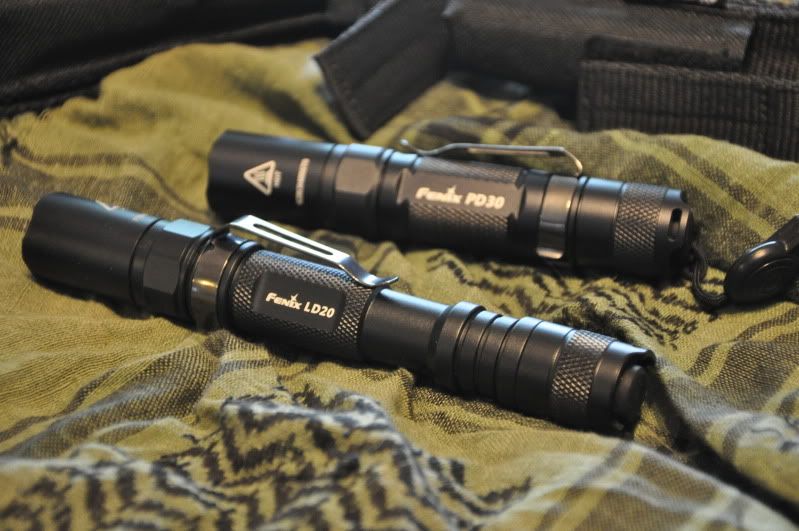
Lights from Fenix - LD20 and PD30

First we'll look at the longer of the two. The LD20 comes with a nylon sheath that is well put together - I can't see any reason you'd have to replace it under normal working circumstances. Unless you beat the heck out of it or are working under rough conditions, this should serve you well. It's got a belt loop on the back as well as a Velcro strip running along the entire length - useful as a MOLLE attachment aid.

Out of the sheath, the light is skinny. That was my initial thought - I'm used to lights that fill out my hand a little. Any hesitation I had about the light was quickly pushed aside once I put 2 double A batteries inside. The tailcap - with a clicky switch on the end, screws off to allow you to put in the required power source. The tailcap also has two attachment points for a lanyard.

The lights specifications, as listed on the Fenix site include:

Features of Fenix LD20: • Cree XP-G LED (R5) with lifespan of 50,000 hours

• Two modes with 6 types of output:
     Turbo Mode: 180 lumens (2h16m) ->Strobe
     General Mode: 5 lumens (100h) - > 30 lumens (15h) -> 81 lumens (5h57m) - > SOS

• Digitally regulated output - maintains constant brightness
• Uses two 1.5V AA (Alkaline, Ni-MH, Lithium) batteries (not included), inexpensive and widely available

• Dimensions
       • Length: 150mm / 5.91in
       • Diameter: 21.5mm / 0.85in
       • Weight: 60grams / 2.1oz (excluding batteries)

• Made of durable T6 aircraft-grade aluminum
• Premium Type III hard-anodized anti-abrasive finish
• Waterproof to IPX-8 Standard
• Toughened ultra-clear glass lens with anti-reflective coating
• Push-button tail cap switch
• Capable of standing up securely on a flat surface to serve as a candle
• Included accessories: holster, lanyard, body clip, two spare o-rings and a rubber switch boot

The light came with some of these accessories, but since it was purchased at a local gun show - out of a box of lights, it's no surprise that everything wasn't included - we didn't even get a box!

The body clip is sturdy and could easily be adapted into a 'pocket light' scenario - EDC or otherwise. A couple spots on the light are kept really skinny, almost hugging the batteries inside, most likely to be used as an attachment point for use as a weapon light.

It has a number of easy-to-see modes. You can select a mode by lightly depressing the tailcap switch momentarily. From strobe to high - all modes work flawlessly.

This light may be 'too' skinny for some, but it's also a bonus feature of it as well - it's small and easy to carry without dedicating a pocket completely to it's storage. It hangs about a half inch out of either side of my hand when grasped in the middle - a larger EDC light than most but definitely viable; maybe has room to be used as an impact device as well.

 
Side by side, the only major difference is size.

The PD30 is much shorter than it's cousin, fitting in my hand completely. It's just as skinny though, and with more lumens to boot.

Features of Fenix PD30:
• Cree XP-G LED (R5) with lifespan of 50,000 hours

• 2 modes with 6 types of output:
     Turbo Mode: 257 lumens (2h37m) ->Strobe
     General Mode: 10 lumens (126h) - > 67 lumens (17h) -> 124 lumens (7h45m) - > SOS

• Digitally regulated output - maintains constant brightness
• Uses two 3V CR123A batteries (Lithium) (not included)

• Dimensions
       • Length: 118mm / 4.65in
       • Diameter: 21.5mm / 0.85in
       • Weight: 53grams / 1.9oz (excluding batteries)

• Made of durable aircraft-grade aluminum
• Premium Type III hard-anodized anti-abrasive finish
• Waterproof to IPX-8 Standard
• Toughened ultra-clear glass lens with anti-reflective coating
• Push-button tail cap switch
• Capable of standing up securely on a flat surface to serve as a candle
• Included accessories: holster, lanyard, body clip, two spare o-rings and a rubber switch boot

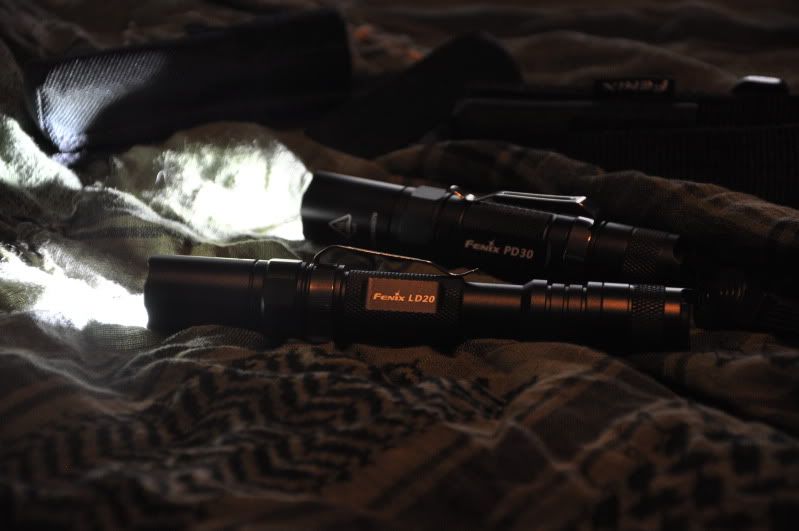
I have no way of effectively measuring the amount of light coming out of either of these lights, except a side by side 'eyeball' test. As seen below, the bottom light, the PD30 - has a different, more bright and white light.


The cost to keep this little light running is more than your mega-pack of AA's, but worth the hassle in the end. The PD30's output is much more vivid, and in a smaller package. Even in broad daylight, if you get a full-face high output beam from this little guy, you can't see who's doing it. Not only is it distracting, I haven't met someone who can just stare at the source without looking away - great as a momentary 'stun' device.

As with the LD - there are a bunch of different things you can use with this light including diffusers and filters for certain tasks. We didn't get any of these items as this light too came from a local show as a discounted item.

At work, I could easily see this being kept in the vehicle, my toolbelt or on my person. It takes up even less room and provides lots of light. It's actually a little heavier than the other, and sits well in the hand.

LD20 & PD30
Depending on your POU - either light is well worth the purchase. Both can easily be used as an EDC lightsource, or as a go-to light when needed. The smaller of the two is more likely to be used as a weapon light, just given it's size in comparison. In saying this - I'd also be more likely to carry it with me every day, in it's sheath or in my pocket.

The only person who might want to stay away from these lights is one who is more used to bigger lights. Maglites and products like them have a certain ergonomic standard to them. If you're used to using big lights, you might fumble around with these little ones - but it's something to consider, given the amount of light these ones can put out.